
Late-Night Mood Board: Rain, Sheer Curtains, Neon, and Warm Rooms
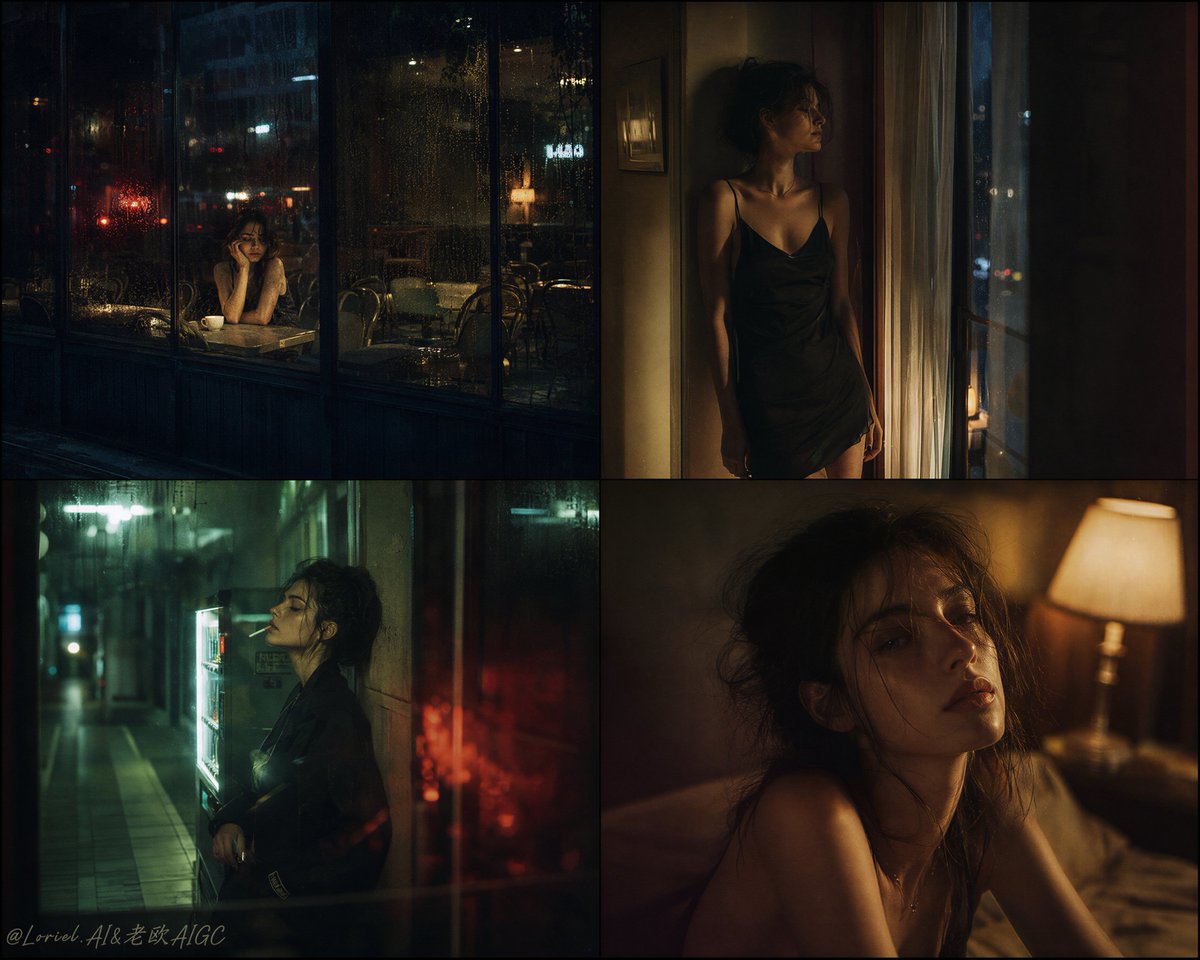
An ultra-premium 4-panel cinematic mood board capturing the humid, melancholic, and intimate feel of late-night urban memories. Each panel tells a different moment of solitude: observation through rain-streaked glass, drift in a hallway, pause under fluorescent light, and intimacy in a motel room. Heavy analog grain, rough print texture, and precise local detail create a dreamlike memory fragment.
Prompt
🌂A late-night mood board: rain-streaked windows, sheer curtains, neon lights, and a cozy room—each tells a story of solitary moments. 深夜的情绪板,雨窗、薄纱、霓虹、暖房各讲一段独处的呼吸。 GPT- image 2 prompt👇 Create an ultra-premium 4-panel cinematic mood board in the “Neon Delay Rooms” direction, using a strict 2x2 grid where all four frames belong to the same humid late-night urban emotional universe, but each panel must feel like a different deep-night memory fragment. The whole board must feel more elusive, more wounded, more emotionally suspended, and more dreamlike than ordinary lifestyle photography. Every frame should carry heavy analog grain, rough print texture, rain haze, diffused neon spill, practical lamp glow, soft smoke-like air, and luxurious low-light realism. No readable text, no logo, no title, no typography, no signage legibility. Core concept: This is a four-part nocturnal memory sequence about delay, solitude, longing, and after-midnight emotional drift. The same emotional world runs through all four frames, but each one captures a different moment of urban pause: waiting, wandering, stopping, and quietly collapsing inward. The women must all be healthy Western female models with refined bone structure, natural beauty, softly athletic elegance, and no influencer-face styling. Their presence must feel lazy, tired, sensual, emotionally distant, and quietly fragile. The whole board must feel like recovered midnight memories rather than posed fashion shots. 4-panel structure: Use a strict 2x2 grid with four equal panels and minimal spacing. The four frames must have strong contrast in shot scale and composition, so the sequence feels cinematic and varied rather than repetitive. Panel 1: distant wide shot through wet glass, strong environmental framing. Panel 2: medium three-quarter interior portrait, body and space relationship clear. Panel 3: tighter close or medium-close urban stopover image with heavier obstruction and tension. Panel 4: intimate close or near-close motel-room fragment with face and emotion dominant. The board must feel visually unified in atmosphere and color, but clearly varied in 景别、镜头压迫感、人物与空间关系、遮挡方式、光源逻辑. Panel 1, rain café distance: A wide, slightly distant shot through rain-streaked café glass at night. A woman sits alone at a table, small within the frame, head leaning into one hand, a cup placed near her. Chairs, table legs, window reflections, wet streaks, and dark empty space around her create emotional isolation. This panel should feel the most observational and detached, like spying on a memory through weather and glass. Use wet reflections, dim practical light, and strong negative space. Panel 2, hallway or apartment drift: A medium shot in a narrow apartment corridor, window corner, or balcony threshold. The woman stands or leans, body visible from thigh or waist upward, face turned partially toward the light, one arm relaxed against a wall or frame. Curtains, wall edges, and a sliver of city light should define the space. This frame should feel more intimate than panel 1, but still suspended and emotionally unreachable. Let the composition be vertical, slightly off-center, with one side falling into rich shadow. Panel 3, fluorescent transit pause: A tighter medium-close scene in a late-night public corner such as a vending-machine corridor, stair landing, underlit convenience-store edge, tiled hallway, or empty station-like passage. The woman pauses mid-thought, leaning against a wall, sitting on a ledge, or standing under a harsh fluorescent spill. Use stronger obstruction in the foreground, such as dirty glass, reflections, frame edges, or neon haze. This frame should feel more unstable, more transient, more like a passing urban wound. The color contrast between sickly green fluorescence and warm residual red or amber glow should be stronger here. Panel 4, motel room intimacy: An intimate close or near-close frame in a dim motel or bedroom-like room. The woman sits on the bed edge, reclines into shadow, or turns her face slightly back toward a soft practical lamp. Her face must be much larger in frame than the other panels, making this the emotional climax of the 4-grid. Use warm tungsten spill, soft haze, and deeper velvet blacks. This frame should feel like the most private and most wounded memory, with expression carrying quiet exhaustion, softness, and withheld emotion. Shot-scale and composition contrast: The four panels must deliberately contrast in shot scale and framing language: one distant observational wide shot, one medium environmental portrait, one compressed transitional medium-close, one intimate emotional close frame. Do not make the four images feel compositionally repetitive. Vary the amount of background, the strength of obstructions, the amount of visible body, and the distance between viewer and subject. Keep all four cinematic, but ensure obvious contrast in visual rhythm. Character direction: Use women with natural facial structure, expressive eyes, real skin texture, softly strong physiques, and understated wardrobe. They must not look glamorous in a conventional commercial way. Hair should feel humid, slightly messy, night-worn, or loosely shaped, catching bits of practical light. Wardrobe should be urban and understated: dark blazer, slip dress, soft knit, camisole, worn blouse, evening top, or sleeveless dark citywear. Clothing must feel tactile, real, and emotionally lived-in. Lighting: Use extremely delicate cinematic low-light design with a strong contrast between warm practical sources and cold ambient spill. Mix tungsten amber, nicotine yellow, muted green fluorescence, deep teal-black, wet crimson reflections, and pale window light. Each panel must have a different lighting balance: panel 1 more rain-softened and reflected, panel 2 more side-window humid glow, panel 3 more fluorescent and fractured, panel 4 more tungsten and intimate. The light must feel diffused through haze, softened by moisture, and emotionally heavy. Atmosphere and effects: Add heavy analog atmosphere: rain on glass, humidity haze, suspended dust, smoke-like room air, faint neon bloom, soft flare, dirty reflections, fogged surfaces, and low-light grain. Let the air feel thick and inhabited. The atmosphere should not be decorative; it should feel like emotional weather. Add subtle motion blur or smear only where it supports the memory-fragment feeling. Printed grain aesthetic: Apply strong heavy analog film grain and coarse print texture across the full board. The image should feel like scanned late-night film stills printed on textured paper, with dense grain, darkroom richness, halation, slight noise in the shadows, tactile low-light roughness, and collector-edition print depth. Grain must be prominent, expensive, and emotionally integral, never cheap or muddy. Extreme sharpness: Despite the heavy grain and haze, preserve razor-sharp emotional focal points in each frame: eyes, lips, fingertips, cup rim, wet window streaks, fabric edges, hair strands, curtain folds, cheekbone highlights, and selected room textures. Faces must remain readable in all four panels. The contrast between rough grain atmosphere and precise local detail is essential. Color direction: Use a mature nocturnal palette of deep bottle green, dirty teal, amber tungsten, nicotine yellow, faded crimson, bruise-purple shadow, concrete gray, and wet black. Keep saturation controlled but emotionally charged. Let each panel lean slightly differently while staying inside one unified late-night city color family. Mood: humid, melancholic, nocturnal, intimate, delayed, lonely, sensual, grain-rich, reflective, cinematic, wounded, luxurious, dreamlike, memory-soaked Rendering style: ultra-premium 4-panel cinematic mood board, late-night urban memory fragments, strong shot-scale contrast, humid neon rooms, rain-streaked glass, practical lamp glow, fluorescent spill, heavy analog grain, coarse print texture, extremely sharp local facial detail, emotionally suspended city-night realism, 8k, world-class image quality Negative prompt: readable text, logo, title layout, crisp advertising typography, cartoon rendering, influencer beauty look, glossy fashion-commercial polish, empty sterile interiors, cheap cyberpunk neon, over-retouched skin, flat composition, repetitive shot scale, low-detail face, weak atmospheric depth
Kynvio Prompt Workflow
How to use this prompt
Open it in Image Studio
Send the prompt to Kynvio AI without starting a generation.
Adapt the details
Replace the subject, setting, colors, text, or composition for your goal.
Review and generate
Choose your final settings, then click Generate when you are ready.
Related GPT Image 2 prompts
GPT Image 2 prompts
About this prompt
Will opening this prompt spend credits?
No. The button only prefills Image Studio. Credits are used only after you start a generation.
Can I edit the prompt first?
Yes. The transferred text is fully editable before you generate an image.