
Burning Haze Fragments: Four-Panel Velvet Portrait
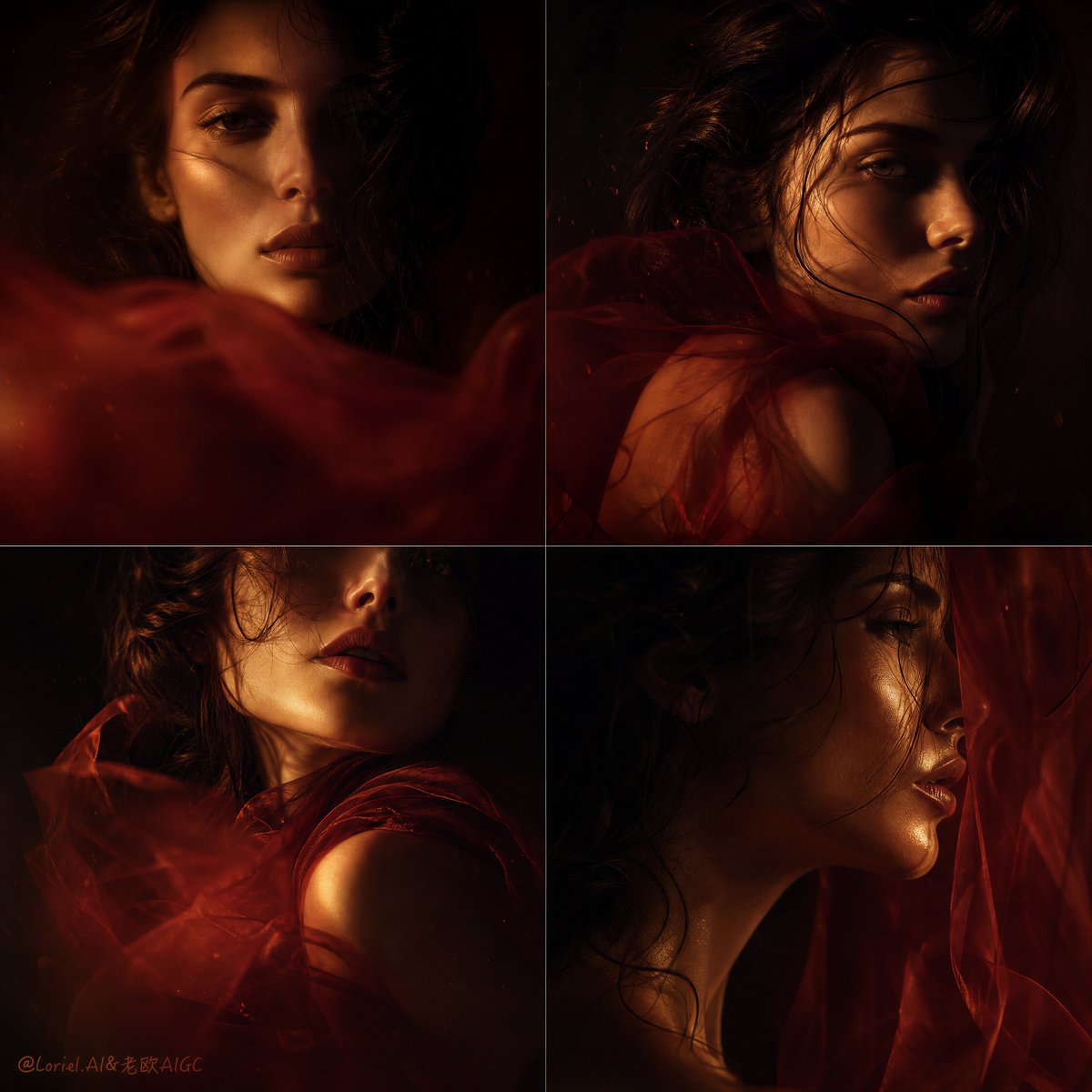
An ultra-premium four-panel portrait artwork in the 'Burning Haze Fragments' direction, built on a strict 2x2 editorial grid with one same heroine, one same translucent crimson fabric language, and one same warm nocturnal cinematic world repeated across four connected images. The board preserves the intimate dream-portrait logic, but this version feels darker, quieter, more velvet-like, and more inward, with deeper shadow mass, more concentrated highlights, and a more restrained cinematic burn. No readable text, logo, title, or graphic layout elements inside the image.
Prompt
Create an ultra-premium four-panel portrait artwork in the “Burning Haze Fragments” direction, built on a strict 2x2 editorial grid with one same heroine, one same translucent crimson fabric language, and one same warm nocturnal cinematic world repeated across four connected images. The board must preserve the same intimate dream-portrait logic, but this version must feel darker, quieter, more velvet-like, and more inward, with deeper shadow mass, more concentrated highlights, and a more restrained cinematic burn. No readable text, no logo, no title, no graphic layout elements inside the image. Core concept: This is a same-series fragmented portrait study where the emotional force comes from controlled repetition and luxurious restraint. The same Western female heroine appears across all four panels, wrapped in translucent ember-red fabric, her face partially revealed through shadow, haze, and drifting cloth. The atmosphere must feel warm but subdued, like the last glow of fire filtered through velvet darkness. The images should feel expensive, intimate, melancholic, and cinematic, with the brightest light only touching selected facial planes, lips, hair strands, and fabric edges. The board must read like four shards of one same nocturnal visual poem. 4-panel structure: Use a clean 2x2 grid with four equal panels and minimal spacing. All four images must belong to the same visual universe: same heroine, same crimson-red gauze language, same deep warm-dark palette, same shallow-depth portrait lens, and same cinematic softness. Variation comes only from crop, angle, and light behavior. Top-left: a close near-frontal fragment with one shoulder lifted and the lower foreground veiled by soft blurred red fabric. Top-right: a stronger three-quarter view with one side of the face disappearing into velvet shadow and a few loose hair strands crossing the temple. Bottom-left: a lower-angle fragment focused on lips, jawline, cheek, and fabric volume, with heavier foreground haze and more concentrated highlight. Bottom-right: a side or half-profile fragment with the cheekbone, eye edge, and neck line touched by a narrow warm glow through translucent fabric. Each panel must feel like part of the same collector-edition cinematic sequence. Heroine: Use one same healthy Western female model across all four frames, with refined bone structure, softly athletic elegance, natural beauty, calm emotional distance, and no influencer styling. Her features should be sculpted but soft: elegant cheekbones, luminous skin, natural lips, and deep expressive eyes. Hair should be dark, loose, and softly wind-disturbed, with fine strands catching selected light. Expression must remain quiet, restrained, and emotionally unreadable, never overtly posed, never glossy commercial beauty. Fabric logic: The red fabric is essential and must feel thin, airy, and expensive, like translucent couture gauze lit from within by warm low light. Use ember red, burnt crimson, rust-red, and dark wine-red translucency, but keep the fabric subdued and integrated into the darkness. In each panel, the fabric should interact differently with the portrait: one frame with fabric drifting across the lower foreground, one frame with fabric touching the neck and shoulder, one frame with gauze partially obscuring the cheek and shoulder contour, one frame with soft translucent fabric hovering between lens and profile edge. The fabric must feel real, floating, tactile, and deeply responsive to light. Fragmentation language: This version must feel more fragmented and more cinematic. The heroine should never be fully revealed in any single panel. Each frame must feel like a controlled partial glimpse: one emphasizing the eye and brow line, one the lips and cheek, one the shoulder and jaw contour, one the side face and hairline. The board should feel like four fragments cut from the same warm shadow dream, with visual continuity but emotional distance. Lighting: Use extremely delicate low-intensity cinematic lighting with concentrated warm highlights and much deeper velvet shadows. The dark areas must feel thicker, richer, softer, and more luxurious, like dark velvet absorbing light. The highlights must be narrower and more intentional, falling only on selected facial planes, lip edges, eyelids, cheekbone ridges, and translucent fabric folds. Across the four panels, vary the direction subtly: one frame with a narrow frontal wash, one with stronger side-light and deep facial falloff, one with a low warm glow rising through haze, one with an edge-lit fragment through fabric translucency. The overall image must feel more contained, more inward, and more filmic than before. Shadow quality: Push the dark zones into a deeper velvet-black and warm umber darkness, with smooth falloff and almost tactile softness. The shadows must not feel empty; they should feel dense, rich, and full of cinematic air. Let the face dissolve gradually into darkness rather than cut sharply. The shadow design is essential to making the board feel expensive and inward. Atmosphere and haze: Add subtle but luxurious atmospheric matter: warm floating dust, faint glowing micro-particles, delicate soft haze, low-contrast smoke-like diffusion, and suspended specks visible only in light shafts and near the fabric edges. The atmosphere should feel intimate and slow, like warm breath and dust suspended in a dark room. Keep all effects restrained and photographic, never decorative, never excessive. Texture and detail: Preserve exceptional realism in skin texture, lip softness, eyelashes, iris reflections, fine hair strands, and translucent fabric weave. The focal details must remain crisp and premium, while the surrounding haze and shadow stay soft and velvety. The contrast between razor-sharp facial features and dreamlike soft blur is essential. Fabric edges should reveal delicate folds, thin layering, and light-sensitive translucency. Depth of field: Use shallow-depth, close-focus portrait optics across all four panels. Let some frames bring the eye or lips into sharp prominence while fabric and hair fall into creamy soft blur. Some foreground gauze can dissolve into warm haze. The focus behavior must feel intimate, expensive, and highly controlled. Background: Keep the background extremely minimal, dark, and atmospheric, within a deep burnt umber, wine-black, charcoal-brown, and muted amber-shadow family. No scenery, no props, no visible room. Only soft tonal drift and warm-dark cinematic void behind the heroine. Color direction: Use a restrained luxury palette of burnt crimson, ember red, dark wine, copper amber, honey-gold highlight, warm skin ivory, deep umber, and charcoal-brown velvet shadow. The highlights must feel more concentrated and precious, while the shadows dominate more of the frame. The entire board should feel lower in brightness, richer in mood, and more expensive in tonal control. Mood: cinematic, inward, restrained, luxurious, warm, melancholic, velvety, dreamlike, intimate, tactile, poetic, shadow-rich, expensive, atmospheric Rendering style: ultra-premium four-panel portrait board, same heroine in four fragmented variations, translucent crimson fabric, deeper velvet shadow, concentrated warm highlights, shallow depth of field, soft haze and floating particles, luxurious cinematic portrait photography, museum-grade visual poetry, 8k, world-class image quality Negative prompt: readable text, logo, title, typography, graphic layout elements, cartoon rendering, influencer styling, plastic skin, cluttered background, extra props, harsh flash lighting, neon colors, cheap beauty retouching, flat shadows, muddy blur, low-detail fabric
Kynvio Prompt Workflow
How to use this prompt
Open it in Image Studio
Send the prompt to Kynvio AI without starting a generation.
Adapt the details
Replace the subject, setting, colors, text, or composition for your goal.
Review and generate
Choose your final settings, then click Generate when you are ready.
Related GPT Image 2 prompts
GPT Image 2 prompts
![Vintage Propaganda Illustration: Hand Gripping [SUBJECT]](https://prompt-media.kynvio.ai/public/prompts/019f82fd-7154-75d8-9665-fa450bafb9dc/019f82fd-746e-70bf-bf91-24f4be3b06de/original.jpg)
About this prompt
Will opening this prompt spend credits?
No. The button only prefills Image Studio. Credits are used only after you start a generation.
Can I edit the prompt first?
Yes. The transferred text is fully editable before you generate an image.