
Ash Fang Sutra: Guardian Beast Head
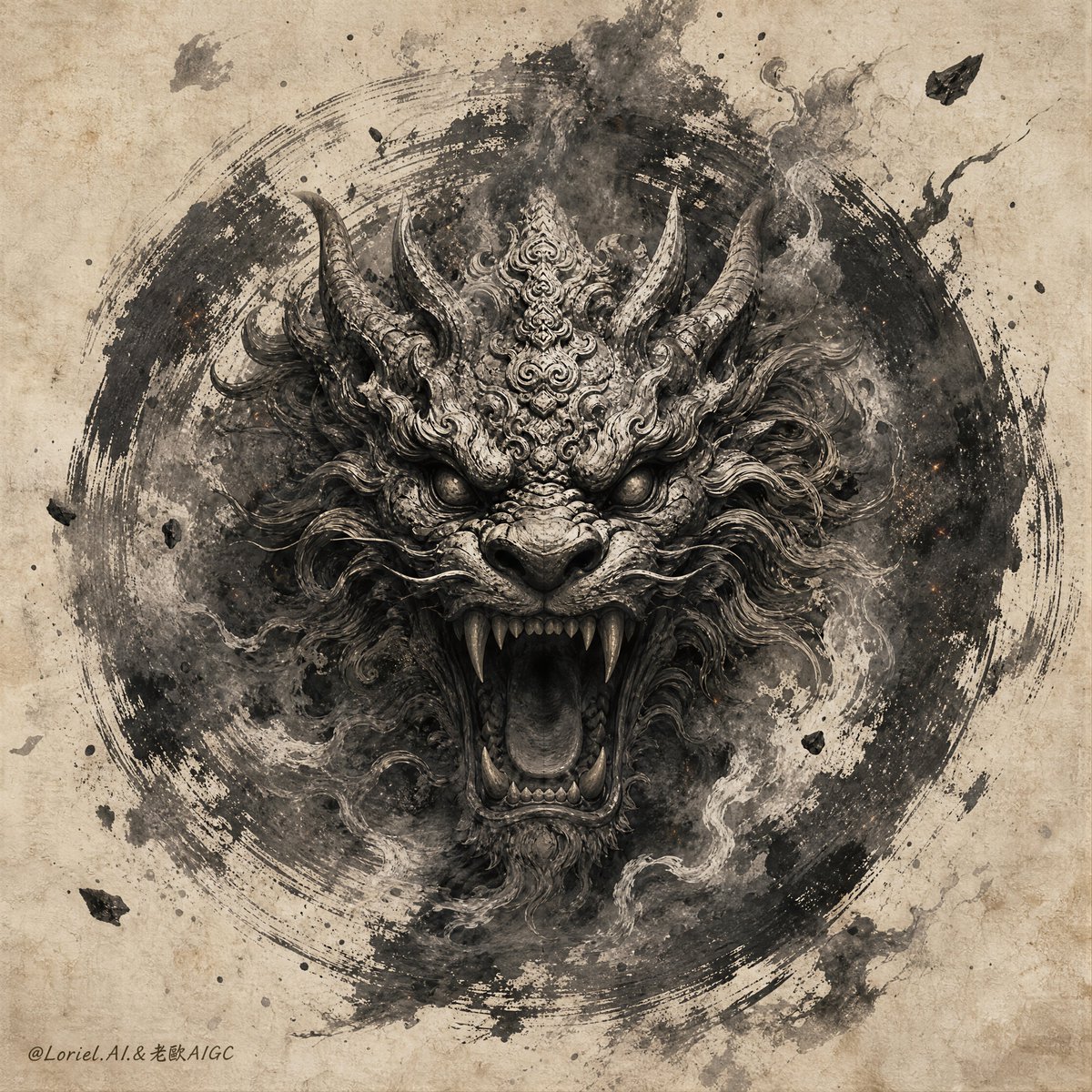
An ultra-premium mythic ink-fantasy artwork depicting an ancient guardian beast head roaring forward from the center of a violent circular ink vortex against a pale aged-paper background. Fuses classical East Asian ink spirit, ancient temple wrath, dark fantasy atmosphere, and high-end archival tactility. An ashen, dry-brush, soot-laden interpretation with rich smoke, flying debris, paper absorption texture, and weathered sacred violence. No readable text, logo, title layout, or symbols.
Prompt
Create an ultra-premium mythic ink-fantasy artwork in the “Ash Fang Sutra” direction, fully preserving the exact logic of the composition: one ancient guardian beast head roaring forward from the center of a violent circular ink vortex, set against a pale aged-paper background. The image must feel like a museum-grade collectible print that fuses classical East Asian ink spirit, ancient temple wrath, dark fantasy atmosphere, and high-end archival tactility. The visual emphasis of this version is a more ashen, dry-brush, soot-laden interpretation of the same structure, with richer smoke, flying gray-black debris, paper absorption texture, and weathered sacred violence. No readable text, no logo, no title layout, no symbols. Core composition: Use a strict centered vertical composition with a single front-facing beast head dominating the middle of the frame. Surround it with a broken circular ring of black-gray brush energy, formed from aggressive dry-brush sweeps, torn ink tails, smoky wash clouds, splattered soot, feathered pigment edges, and fraying black matter. The ring must feel incomplete and alive, as if it were a sacred seal violently disturbed. The beast must burst forward from the central void of this ash-black vortex, creating a direct confrontational frontal presence. The pale paper around it must stay largely open and minimal so the ink structure and beast head remain overwhelming. Beast design: Render the creature as an ancient Chinese guardian beast, a dark sacred fusion of lion, dragon, temple guardian, and carved relic spirit. The head must be front-facing and roaring, with a monumental forehead, layered brow ridges, flared nostrils, deep eye recesses, exposed upper and lower fangs, and a wide open mouth full of predatory detail. Horns or crown-like ridges should rise from the head with a carved ceremonial quality. The mane must spread outward in dense layered strands that feel halfway between hair, carved flame, smoke ribbons, and weathered ink plumes. The whole creature must feel ancient, wrathful, sacred, and tactile, like a relic summoned through ash and soot. Ash and dry-brush logic: This version must strongly intensify the gray-black ash quality of the image. Push the ink language away from smooth pure-black mass and toward rich dry-brush abrasion, powdery soot, layered smoke-wash transitions, and textured paper absorption. The circular vortex should be built from streaky brush marks, dragged pigment, broken bristle textures, cracked tonal edges, and charcoal-like friction. Let the beast appear partially formed from ash fog and eroded pigment, as if it is emerging through centuries of burnt ritual residue. The image should feel ancient, dusted, scorched, and spiritually weathered. Fluid effects and particles: Surround the beast and vortex with extremely refined atmospheric matter: floating ash dust, smoky soot clouds, drifting black-gray particles, fine debris specks, faint ember-brown traces, soft pigment spray, and dissolving vapor strands. These effects must remain integrated with the ink medium, not digital or synthetic. Let the atmosphere feel heavy with ancient particulate matter, as if the image has been breathed into being through smoke, ritual fire, and burnt paper memory. The particles must increase the sense of sacred emergence and violent stillness. Lighting: Use extremely delicate sculptural lighting to draw the beast out of the ash-darkness. Add soft pale illumination from the upper front so that the forehead planes, brow ridges, nose bridge, fangs, upper lip, and selected mane layers catch a refined silver-gray highlight. The deep interior of the mouth, eye sockets, and the core of the ink vortex should remain rich and shadowed. The lighting must never feel glossy or modern; it should feel like old light passing across carved soot-black stone and thick ink residue. The overall effect must be subtle, dimensional, and luxurious. Material and texture: The beast should feel like a fusion of carved charred wood, soot-dark stone, ink pigment, temple relic bronze-shadow, and living smoke. Show minute surface weathering, erosion lines, cracked ornamental ridges, rough matte planes, and dense mane layering. The ink vortex must feel just as physical: powdery brush drag, dry paper scrape, smoke bloom, soft pigment clumping, and feathered edge absorption into fibrous paper. Everything must feel hand-made, ancient, and extraordinarily tactile. Background: Use a pale aged-paper background in warm ash-ivory, smoked beige, and faded parchment cream. The paper must show subtle fiber texture, very soft staining, faint pressure marks, and elegant collector-edition wear. Keep the background mostly empty and quiet, with no readable text, no typographic elements, no symbols, and no graphic overlays. The open paper space is crucial to the power of the central beast-vortex structure. Printed grain aesthetic: Apply a strong heavy archival print-grain treatment across the full artwork. The image must feel like a rare oversized print with dense analog grain, visible paper tooth, subtle scan texture, dust contamination, slight ink irregularity, and luxurious aged-print tactility. The grain must be especially noticeable in the pale paper background, gray smoke transitions, low-contrast ash fields, and frayed edges of the brushwork. It should enhance the antique sacred feeling without making the artwork muddy or low-resolution. Extreme sharpness: Despite the heavy print grain and smoke softness, preserve exceptional sharpness on the beast’s key anatomy. The eyes, brow carving, nostril rims, fang edges, gum forms, horn contours, forehead ornament, and mane filaments must remain extremely crisp and highly resolved. The beast should cut through the ash-rich atmosphere with razor-sharp authority. The contrast between weathered print texture and extreme sculptural clarity is essential to this version. Color direction: Use a restrained near-monochrome palette of parchment ivory, smoked beige, ash gray, soot black, charcoal, dusted silver-gray, and the faintest traces of ember-brown warmth buried deep in the smoke. The image should feel colder, drier, older, and more ceremonial than a warm black-ink version. Overall the palette must remain elegant, ancient, and luxurious. Mood: wrathful, ancient, sacred, ash-laden, ceremonial, mythic, weathered, dark, confrontational, luxurious, collectible, haunting, ritualistic, museum-grade Rendering style: ultra-premium dark ink fantasy artwork, front-facing guardian beast head, ash-black circular dry-brush vortex, East Asian ink painting fusion, heavy smoke and soot particles, dense archival print grain, extremely sharp sculptural detail, aged parchment background, museum-grade collectible art, 8k, world-class image quality Negative prompt: readable text, logo, title layout, symbols, modern graphic design, cartoon rendering, neon color, smooth vector brushstroke, weak beast anatomy, soft blurry detail, flat lighting, cheap fantasy effects, cluttered background, glossy modern finish, low-detail mane, muddy low-quality grain
Kynvio Prompt Workflow
How to use this prompt
Open it in Image Studio
Send the prompt to Kynvio AI without starting a generation.
Adapt the details
Replace the subject, setting, colors, text, or composition for your goal.
Review and generate
Choose your final settings, then click Generate when you are ready.
Related GPT Image 2 prompts
GPT Image 2 prompts
About this prompt
Will opening this prompt spend credits?
No. The button only prefills Image Studio. Credits are used only after you start a generation.
Can I edit the prompt first?
Yes. The transferred text is fully editable before you generate an image.