
Ant Anatomy Regions & Function
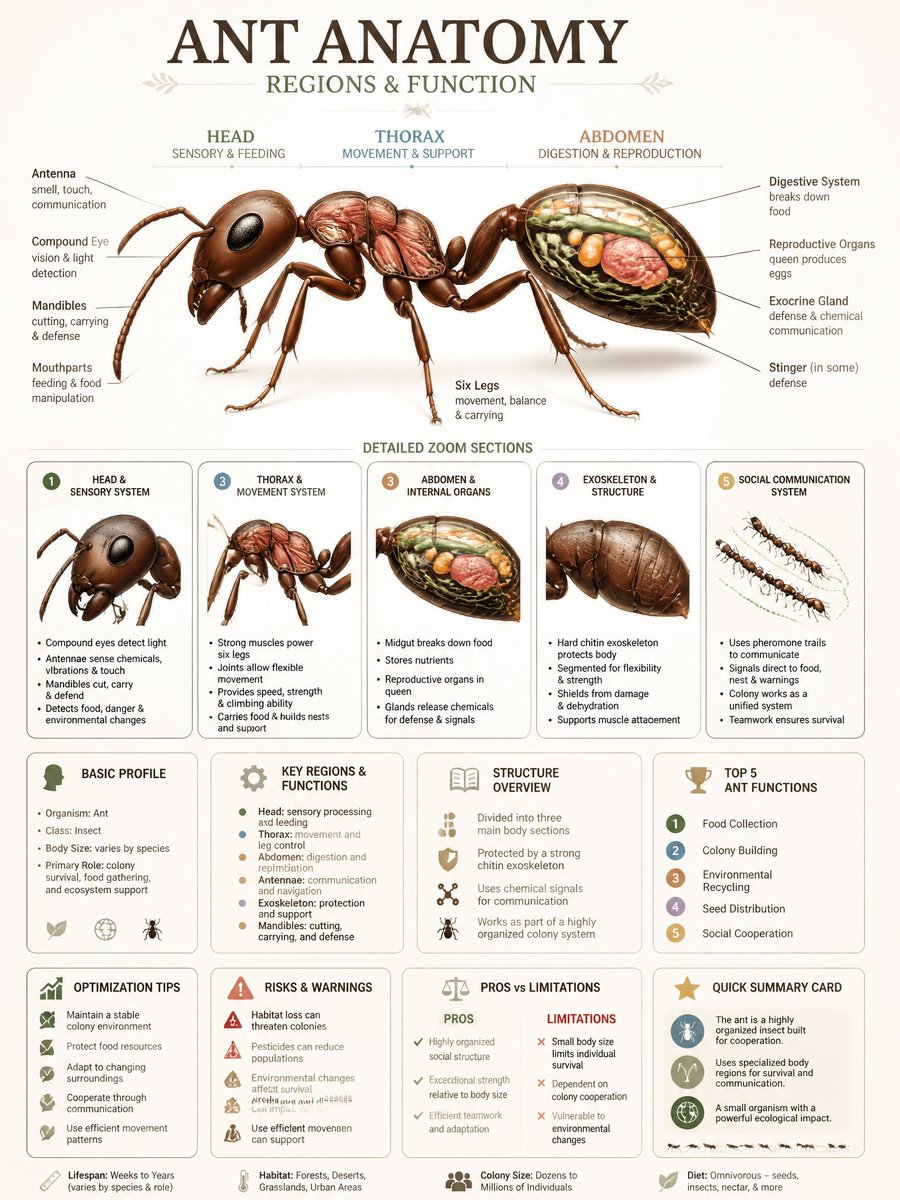
A high-quality infographic about ant anatomy, showing body regions, internal organs, zoom panels, and info panels in a premium natural-history guidebook meets modern editorial style.
Prompt
{ "type": "image_prompt", "title": "Ant Anatomy Regions & Function", "style": { "overall": "premium natural-history guidebook meets modern editorial infographic", "tone": "educational, refined, collectible, highly structured", "background": "clean light-colored", "palette": "soft, elegant, muted scientific tones (earth browns, warm grays, subtle greens, gentle blues)", "lighting": "gentle shadows, soft highlights", "layout": "vertical, modular, high information density but uncluttered" }, "composition": { "main_subject": { "type": "detailed anatomical illustration", "description": "highly detailed ant with clearly defined body segments, internal organs, legs, antennae, and biological structures", "style": "semi-realistic scientific illustration with soft shading", "placement": "upper-middle focal area", "labels": "major ant regions labeled with fine callouts" }, "zoom_sections": [ { "focus": "head and sensory system", "description": "zoomed-in panel showing compound eyes, antennae, mandibles, communication, and environmental sensing" }, { "focus": "thorax and movement system", "description": "zoomed-in panel showing muscles, six legs, joints, and powerful movement mechanics" }, { "focus": "abdomen and internal organs", "description": "zoomed-in panel showing digestive system, reproductive organs, and defensive functions" }, { "focus": "exoskeleton", "description": "detailed view showing protective outer shell, body segments, and structural strength" }, { "focus": "social communication system", "description": "panel showing pheromone trails, colony communication, and teamwork behavior" } ], "info_panels": [ { "title": "Basic Profile", "content": [ "Organism: Ant", "Class: Insect", "Body Size: varies by species", "Primary Role: colony survival, food gathering, and ecosystem support" ] }, { "title": "Key Regions & Functions", "content": [ "Head: sensory processing and feeding", "Thorax: movement and leg control", "Abdomen: digestion and reproduction", "Antennae: communication and navigation", "Exoskeleton: protection and support", "Mandibles: cutting, carrying, and defense" ] }, { "title": "Structure Overview", "content": [ "Divided into three main body sections", "Protected by a strong chitin exoskeleton", "Uses chemical signals for communication", "Works as part of a highly organized colony system" ] }, { "title": "Top 5 Ant Functions", "content": [ "Food Collection", "Colony Building", "Environmental Recycling", "Seed Distribution", "Social Cooperation" ], "visual_style": "ranked list or icon-based scoring" }, { "title": "Optimization Tips", "content": [ "Maintain a stable colony environment", "Protect food resources", "Adapt to changing surroundings", "Cooperate through communication", "Use efficient movement patterns" ] }, { "title": "Risks & Warnings", "content": [ "Habitat loss can threaten colonies", "Pesticides can reduce populations", "Environmental changes affect survival", "Predators and diseases can impact colonies" ] }, { "title": "Pros vs Limitations", "content": { "pros": [ "Highly organized social structure", "Exceptional strength relative to body size", "Efficient teamwork and adaptation" ], "cons": [ "Small body size limits individual survival", "Dependent on colony cooperation", "Vulnerable to environmental changes" ] } }, { "title": "Quick Summary Card", "content": [ "The ant is a highly organized insect built for cooperation", "Uses specialized body regions for survival and communication", "A small organism with a powerful ecological impact" ], "visual_style": "highlight box with icons" } ] }, "visual_elements": { "icons": "small, refined, minimal scientific icons", "boxes": "rounded corners with subtle borders", "typography": { "title": "large, elegant, high contrast", "subheadings": "clear hierarchy", "body": "clean, readable, compact" }, "connectors": "thin lines linking labels to ant regions", "decor": "subtle grid or editorial alignment guides" }, "design_goals": [ "knowledge integration", "modular information design", "encyclopedia-style clarity", "high readability", "shareable infographic aesthetic", "non-commercial, reference-style presentation" ] }
Kynvio Prompt Workflow
How to use this prompt
Open it in Image Studio
Send the prompt to Kynvio AI without starting a generation.
Adapt the details
Replace the subject, setting, colors, text, or composition for your goal.
Review and generate
Choose your final settings, then click Generate when you are ready.
About this prompt
Will opening this prompt spend credits?
No. The button only prefills Image Studio. Credits are used only after you start a generation.
Can I edit the prompt first?
Yes. The transferred text is fully editable before you generate an image.